Aethyr ADHD privacy policy · All apps · Worldwide
Your life stays
with you.
Aethyr is designed around one promise: your personal information stays on your device.
This policy covers every app under the Aethyr ADHD name: the Aethyr ADHD app on both iPhone and iPad (iOS) and Android, A E T H Y R — the spin-off app built from it, for iPhone, iPad and Apple Watch — and this website. The two apps are genuinely different, so every chapter below is labelled with the app it covers: Aethyr ADHD only, A E T H Y R only, or both. Nothing has to be guessed at or carried over from another chapter.
In plain terms, for every kind of data described below: it is not collected by us, it is not shared by us, it is used strictly to make a feature you asked for work, and you can delete it yourself at any time. We hold no servers containing your data, we operate no accounts, and we sell nothing. Each item below states exactly why it is used and what happens to it.
Effective and last updated: 12 September 2026
The short version
On-device by default.
No account. No advertising. No tracking.
Both apps
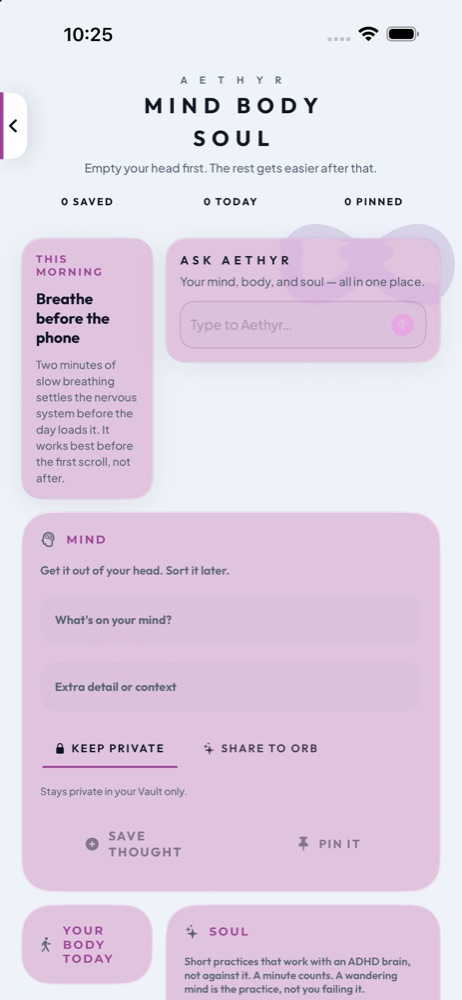
Your thoughts, feelings, reminders, medication, diary, tasks, journeys, saved items and other content are stored only on your device.
Aethyr does not operate servers that store your personal content and does not sell, rent or share it.
Looking something up online is the one optional exception, and the two apps do it differently. Aethyr ADHD asks permission every session and sends only the words you type. A E T H Y R searches openly, in Safari, and is covered in its own chapter below.
Information stored on your device
Both apps
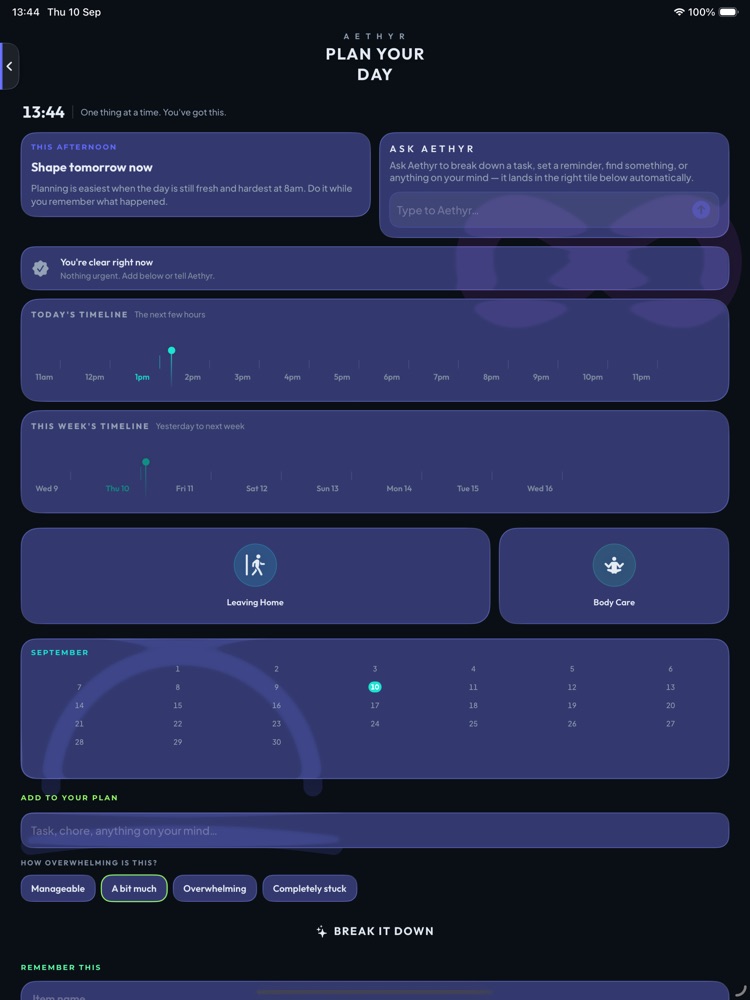
Aethyr lets you capture and organise personal information including thoughts, feelings and mood entries, reminders, medication names and schedules, diary and journal entries, tasks and task breakdowns, saved items and places, focus-timer settings and app preferences.
All of this is stored locally on your device. It is not transmitted to us or a third party. We cannot see it, access it or recover it. If you delete the app, this information is removed with it, subject to any device backup you have set up yourself through Apple iCloud or Google.
There is nothing built into either app to watch how you use it, report on you, or advertise to you.
The one optional exception
Online Safe Search asks first.
Aethyr ADHD only
Some results are produced entirely on your device from built-in content or your phone’s own built-in intelligence. Nothing leaves your device in those cases.
If an online lookup is required, Aethyr clearly explains that only the words you typed will be sent and names the source. Nothing happens until you allow it.
Currently, online information may come from Wikipedia, operated by the Wikimedia Foundation. The result is shown as a text card inside Aethyr; no browser page opens. Permission lasts only for the current session.
What Safe Search never sends
Aethyr ADHD only
Your diary, thoughts, feelings, medication information, reminders, tasks, contacts, identifiers and other personal content are never sent. Only the specific search words you type are sent, and only with permission. Your location is never sent to a search provider; the one place location is used is described in section 03 below.
Why search words are sent. Only to fetch the answer you asked for. They are not collected by us, not shared by us, not stored, and never used for advertising, profiling or analytics. Aethyr never sees a history of your searches because none is kept.
An online provider necessarily receives those search words and standard technical information such as your IP address, and handles the request under its own privacy policy. Read the Wikimedia Foundation Privacy Policy.
ADHD Support Search opens only approved, safety-reviewed resources. A selected website may receive your search words and standard request information. Aethyr does not receive, store or retain those searches.
Feature by feature: what each one uses, and why
Aethyr ADHD only
Every permission Aethyr ADHD asks for belongs to a specific feature. Nothing is requested "just in case". Each feature below is optional, asks permission first, and the rest of the app works without it. For all of them: not collected by us, not shared by us, used only to make that feature work, and deletable by you.
The two apps do not ask for the same things. Aethyr ADHD on iPhone, iPad and Apple Watch follows Apple's rules and asks for several things the Android app does not; the Android app follows Google's rules and asks for less. Where a permission exists on only one platform it says so below, rather than being written as though it applied to both.
This chapter describes Aethyr ADHD. A E T H Y R — the other app in the family — asks for more than this, and in a few places asks differently. It is covered in full in chapter 08, rather than assumed from what's below.
Day Ahead — weather
Uses: approximate or precise location.
Why: to show the forecast for where you actually are, so "leave at half eight" can account for the weather.
What happens: your coordinates alone are sent to Open-Meteo, an independent weather service, which returns the forecast. Your name, entries and any other personal content are never included. Aethyr does not store the coordinates and keeps no location history.
Turn it off: refuse or withdraw location permission in your device settings. You lose automatic weather, nothing else.
Location reminders and leaving-home checks
Uses: precise location, including in the background.
Why: so a reminder you tied to a place — "grab the parcel when I get to the car" — can actually reach you when you arrive, which needs checking while the app is closed.
What happens: the check runs entirely on your device. Your location is not sent to us or to anyone else, and no route or history is recorded.
Turn it off: decline background location, or delete the location reminder.
Aethyr Music — Apple Music
Uses: an Apple Music sign-in, on both iOS and Android.
Why: so you can play your own music inside Aethyr without leaving the app and falling into a distraction spiral.
What happens: you sign in to Apple, not to Aethyr. Your sign-in, your library and what you play are handled by Apple under Apple's own privacy policy. Aethyr never receives or stores your Apple account details, your listening history or your library.
Turn it off: simply do not sign in, or sign out. Music is the only feature affected.
Health Hub and Brain Fuel — health and fitness
This works differently on iPhone and on Android, and the difference is deliberate. Each platform follows its own rules: iOS uses Apple Health under Apple's own rules, and the Android app uses no health platform at all.
On iPhone and Apple Watch — Apple Health.
Uses: read access to the figures you allow, and write access for sessions you complete in Aethyr.
Why: so you can see your own body data beside your notes, and so a session you finish is written into your own health app rather than lost inside ours.
What Aethyr can read, only with your permission: steps, sleep analysis, heart rate, heart rate variability, resting heart rate, active energy, exercise time, stand hours, blood pressure, body mass, body mass index, body fat, lean body mass, height, waist circumference, water, caffeine, oxygen saturation, respiratory rate, VO2 max, wrist temperature during sleep, time in daylight, mindful sessions and State of Mind.
What Aethyr writes back: workouts, mindful sessions, and a State of Mind entry when you log a feeling — so a mood you record in Aethyr appears in Apple Health's own trends and is not locked inside one app.
What happens: read and displayed on your device only. Never transmitted to us or to anyone else. Aethyr does not interpret it, score it or give health advice.
Turn it off: withdraw the permission in Apple Health and the figures disappear from Aethyr. Anything already written to Apple Health belongs to you and stays there until you remove it.
On Android — no health platform, and nothing is read.
The Android app does not use Health Connect and requests no Health Connect permission of any kind. It reads no steps, no sleep, no heart rate, no activity and no nutrition from your phone, and it writes nothing back to any health app.
What this means for Health Hub: on Android, everything in Health Hub is what you typed — your medication, your doses, and any blood pressure, pulse or weight you chose to record. Nothing appears there that you did not enter yourself.
What this means for Brain Fuel: movement is detected using the physical activity permission on your device, which tells Aethyr whether you are moving. That is a separate permission, it is not health data, and it never leaves your phone.
Contacts (iPhone and iPad only)
Uses: your contacts.
Why: so you can pick an address you already have saved when planning a journey in Drive Now, instead of typing it out.
What happens: your contacts are read on your device when you open the picker. They are never uploaded, never shared and never copied into Aethyr's own storage — only the address you choose is used, for that journey.
Turn it off: decline the permission and type the address instead. The Android app does not ask for contacts at all.
Your iOS Reminders (iPhone and iPad only)
Uses: read access to Apple's own Reminders app.
Why: so what is due today or carrying forward in Reminders appears alongside your Aethyr tasks, and you have one picture instead of re-entering everything twice.
What happens: your reminders are read on your device and displayed. They are never transmitted to us or anyone else, and Aethyr does not modify or delete them.
Turn it off: decline the permission; your Aethyr tasks are unaffected. The Android app does not read any other app's reminders.
Leaving alarms (iPhone and iPad only)
Uses: Apple's own alarms.
Why: so a "time to leave" alert can still reach you when your phone is on silent — which is exactly when an ADHD brain most needs it.
What happens: the alarm is set on your device, only when you choose to set one. No data leaves your phone.
Turn it off: do not set a leaving alarm, or remove it.
Movement and motion
Uses: your device's movement activity — walking, running, still.
Why: so Brain Fuel and Drive Now can respond to what you are actually doing, such as noticing you have been sitting still for a long stretch.
What happens: read on your device only and never transmitted. It tells Aethyr whether you are moving; it is not health data and it is not a location.
On iPhone this is Apple's motion permission. On Android it is the physical activity permission. Both are optional and both stay on the phone.
Turn it off: decline the permission.
Face ID, Touch ID and device unlock
Uses: your device's own biometric unlock.
Why: so the Private Vault, your diary and — if you switch it on — the whole app can be locked behind the same check that protects your phone.
What happens: the check is performed by your device. Aethyr is told only whether it succeeded. Your fingerprint or face is never seen by Aethyr, never stored by Aethyr and never leaves your device — it is held in your phone's secure hardware, which no app can read.
Turn it off: leave App Lock and Vault biometrics off in Settings.
Apple Watch (iPhone only)
Uses: the Aethyr watch app, and the health figures you have already allowed on iPhone.
Why: so you can capture a thought or check your day from your wrist.
What happens: the watch app reads only what you have already permitted in Apple Health and talks to your own iPhone. Nothing goes to us. There is no Wear OS equivalent that reads health data on Android, because the Android app has no health access at all.
Speech recognition (iPhone and iPad)
Uses: speech recognition, alongside the microphone.
Why: to turn what you say into text so you can capture a thought without typing.
What happens: on iOS this is a permission separate from the microphone itself, and Apple asks for both. The words become text and the audio is not kept by Aethyr. On Android the same job is done by your phone's own recogniser under the microphone permission, with no separate request.
Turn it off: decline either permission and type instead. Aethyr always replies in writing and never speaks back.
Safe Search — online lookups
Uses: the words you type, and only when you allow it.
Why: to fetch a plain answer from a trusted source without opening a browser full of distractions.
What happens: only your typed words are sent, to a named provider, for that one lookup. Aethyr does not receive, store or retain them, and keeps no search history.
Turn it off: tap "Not now". On-device results need no permission at all.
Camera — medication label and item photos
Uses: the camera.
Why: to read a medication label so you do not have to type it, and to photograph where you put something.
What happens: images are processed on your device and stay there. No photo is uploaded.
Turn it off: decline camera permission and type the details instead.
Microphone — voice capture
Uses: the microphone.
Why: so you can speak a thought instead of typing it.
What happens: speech is turned into text by your phone's own on-device recogniser. No audio recording leaves your device, and Aethyr keeps none.
Turn it off: decline microphone permission and type instead.
Calendar and notifications
Uses: your calendar, and permission to send notifications.
Why: to show what is actually on today in Day Ahead, and to deliver the reminders you set.
What happens: your calendar is read on your device and never transmitted. Notifications are generated on your device; they are not push messages from us.
Turn it off: decline either permission; reminders will still be saved, they simply will not alert you.
Screen Time — holding apps during a focus session (iPhone and iPad only)
Uses: Apple's own Screen Time permission, for you alone.
Why: so that when you start a focus session, you can ask Aethyr to hold a few distracting apps shut until it ends.
What happens: you choose the apps yourself, in Apple's own picker. Apple's picker hands Aethyr back a sealed reference rather than app names — Aethyr can pass it back to the system to apply the hold, but cannot read it. It cannot log or send which apps you chose, because Apple built it so that it cannot. This isn't "data we don't share": there is genuinely nothing for Aethyr to collect. That sealed reference stays on your device and never leaves it. The hold lifts by itself when the session ends, whether or not Aethyr is open.
One person, one device. Despite the name Apple gives it, this is Screen Time used for self-restriction only — the owner of the phone limiting their own apps. It is unrelated to the Children category in Aethyr's Settings, shares no code with it, and processes no second person's data.
Turn it off: decline the Screen Time permission, or start a session without choosing any apps to hold. The rest of the focus session works exactly the same either way. The Android app does not use Screen Time at all.
Children and young people
Both apps
Aethyr may be used by people under 18. Aethyr does not create user profiles, require an account or collect personal information for advertising or tracking.
Safe Search applies safety checks, limits online lookups to trusted moderated sources and requires explicit permission each session. Parents and guardians can contact aethyr@aethyradhd.com.
What we do not do
Data security
Both apps
Because personal content stays on your device, its security is tied to your device protections: your passcode or PIN, biometric unlock (Face ID or Touch ID on iOS, fingerprint or face unlock on Android) and the operating system’s own built-in security.
Keep your device updated and protected with a passcode or biometric lock.
Your choices and rights
Both apps
Safe Search: decline online lookups at any time by tapping “Not now”. On-device results need no permission.
Deleting data: delete individual entries inside Aethyr, or delete the app to remove locally stored content from the device.
Region-specific rights: UK GDPR, EU GDPR, the California Consumer Privacy Act and other laws may give you rights regarding personal data. Because Aethyr does not hold your personal content on its systems, your information remains under your control. Questions can be sent to aethyr@aethyradhd.com.
How long information is kept
Aethyr ADHD only
This chapter describes Aethyr ADHD. Aethyr's retention model is different, with no automatic deletion at all — see chapter 08.
We do not store or retain your personal content. Aethyr has no servers holding user data, no accounts and no backups under our control. There is nothing on our systems to retain, and nothing for us to delete on your behalf.
On your device. Your entries stay on your device until you remove them. You can delete individual entries at any time, clear everything from Settings, or delete the app, which removes locally stored content with it. Content may persist in any device backup you have set up yourself with Apple or Google; those backups are under your control, not ours.
How long your notes are kept — this differs by platform, and the difference is deliberate. The Android app follows Google's rules and the iPhone app follows Apple's, so the two are described separately below rather than averaged into one sentence that would be true of neither.
On Android — you choose, and the default is 90 days. In Settings you pick how long Aethyr keeps what you capture: 30 days, 90 days, 6 months or 12 months — the months are calendar months, so a leap year does not shorten them. Once something passes the age you chose it is deleted from your device — not hidden, not archived, deleted. This covers what you capture: offloads, thoughts, feelings, tasks, reminders, journeys, saved places and saved conversations.
Three things are never deleted by this. Your medication history — what you take, your doses and any blood pressure, pulse or weight you recorded — because it is a health record you may need to show a clinician, and losing it quietly would be the worst thing this app could do to you. Anything in the Private Vault, which is the deliberate long-term store. And anything you have pinned, because pinning is you saying "not this one".
If you choose a window shorter than six months, Aethyr asks you once every 20 days whether it is still what you want. Choose six months or longer and it stops asking.
On iPhone and iPad, in Aethyr ADHD — a rolling six calendar months. The iPhone app keeps a fixed six-month window rather than a choice. When the window moves on, the diary source data older than it is removed from your device, and on iOS that removal also includes your medication logs, wear-off notes and vitals readings. This applies to Aethyr ADHD only — A E T H Y R deletes nothing automatically, ever. Between the two ADHD platforms this is the one place they genuinely behave differently, and it is stated here rather than glossed over: on iPhone your older medication history is cleared with everything else, on Android it is kept.
Exporting before anything goes. On both platforms you can export your diary to a CSV file at any time, and on iPhone monthly files are written automatically and overwritten rather than accumulated, so the app does not grow without limit. An export is yours: it lands in a folder you choose and Aethyr has no copy of it.
Apple Music. If you use Aethyr Music and choose to sign in, you are signing in to Apple Music. Your sign-in and what you play are handled by Apple under Apple’s own privacy policy. Aethyr does not receive or store your Apple account details or your listening history.
Location. Coordinates sent for a weather forecast are used for that request and are not stored by Aethyr. We keep no location history.
Health and fitness data. On Android there is none: the Android app uses no Health Connect permission of any kind, reads no health figures from your phone and writes none back, so there is nothing of this sort to retain. Everything in Health Hub on Android is what you typed yourself. On iPhone, if you allow it, Aethyr reads figures from Apple Health and can write workouts, mindful sessions and a State of Mind entry back. Those figures are read and displayed on your device only, are never transmitted to us or to anyone else, never collected by us and never shared by us, and Aethyr does not interpret them, score them or give health advice. Aethyr keeps no copy of its own: withdraw the permission in Apple Health and the figures disappear from the app. Anything Aethyr wrote into Apple Health belongs to you and stays there until you remove it.
Search words. Words you choose to send for an online lookup are used for that lookup only. Aethyr does not receive, store or retain them. The provider handles the request under its own policy and retention rules.
A E T H Y R — part of the Aethyr ADHD family
A E T H Y R only
This chapter covers A E T H Y R — part of the Aethyr ADHD family, built on the same system and opened up to anyone — for iPhone, iPad and Apple Watch (iOS 26.6 or later; there is no Android version). It is an 18+ app.
A E T H Y R keeps every promise Aethyr ADHD makes about your data: no accounts, no servers of ours, no advertising, no tracking, and nothing collected, shared or sold by us. What changes is not the promise. What changes is how far the app is allowed to reach on your behalf, and that difference is set out in full below rather than left to be inferred from the Aethyr ADHD chapters above.
What A E T H Y R is allowed to do that Aethyr ADHD is not
Aethyr ADHD is deliberately fenced in. It was built for one purpose, and its limits are part of the design: search returns plain text from a short, hand-reviewed list of trusted sources and asks permission every session; it reads your Reminders but cannot write to them; medication is scoped to one category of medicine; and what you capture is cleared on a rolling six-month window.
A E T H Y R was built for people who need the whole thing, so those fences are not there. In plain terms:
- It can reach the open web. You can search for anything and the result opens in Safari, rather than being fetched as stripped text from an approved list. This is the single biggest difference between the two apps, and it is described in full under Search below.
- Any medicine, not one category. A E T H Y R accepts any medication you type or scan off the box, not a fixed list.
- Maps without restriction. Any address, any destination, any saved place.
- Calendars and Reminders both ways. Aethyr ADHD only reads your Reminders. A E T H Y R has full read and write access to both Calendars and Reminders, so something you create or complete in the app can appear in Apple’s own apps too.
- Apple Health both ways, and in the background. It reads the figures you allow, writes what you record yourself, and can be updated by Apple Health without you opening it first.
- Your home. With permission it reads your HomeKit lights and locks and can control them.
- Background location. For journeys, saved places and location reminders you set.
- Nothing is deleted on a timer. There is no six-month window and no retention setting. What you write stays until you delete it.
What A E T H Y R still will not do
Wider reach is not the absence of limits, and the ones that remain are deliberate:
- Two categories are refused outright, in every country — described under Search below. A refused search is never run, never sent anywhere and never remembered.
- It cannot route around your phone’s own protections. Results open in Apple’s browser, not a web view of Aethyr’s own, specifically so that whatever restrictions are configured on the device still apply.
- It asks iOS how old you are before offering adult topics in suggested searches, and fails closed if it is not told.
- It still has no servers, no accounts and no outside company’s code in it. Reaching further out into the world does not mean sending your life along with it: what you write stays on your device, or in your own iCloud if you turn that on.
Every permission A E T H Y R asks for is optional, is asked for in plain words at the moment it is needed, and can be withdrawn in your device settings afterwards. The rest of the app keeps working without it.
Permissions A E T H Y R asks for, for the same reasons as Aethyr ADHD
A E T H Y R asks for Camera, Photos, Microphone, Speech, Contacts, Motion and Face ID, for the same reasons already described for Aethyr ADHD in chapter 03: reading a medication label or photographing where you put something (Camera — and Photos, to choose a picture you already have instead of taking a new one), speaking a thought instead of typing it (Microphone and Speech), picking a saved address for a journey (Contacts), noticing whether you're moving (Motion), and locking the Vault, diary or app behind your device's own biometric check (Face ID). The same guarantees apply to every one of them: processed on your device, not collected by us, not shared by us, and each one optional.
Calendars and Reminders — full access, not just read
Aethyr ADHD reads your iOS Reminders. A E T H Y R goes further: it has full read and write access to both Calendars and Reminders, so an item you create or complete in A E T H Y R can also appear, or be updated, in your own Calendar and Reminders apps — not just be displayed alongside them. This still runs entirely on your device; nothing about what's in your calendar or reminders is sent to us.
Health — reading, writing, and keeping up to date
Health Hub in A E T H Y R uses Apple Health the same way described for Aethyr ADHD's iPhone app in chapter 03 — read access to the figures you allow, write access for what you log in A E T H Y R. A E T H Y R can also be updated in the background, so a change in Apple Health — a new reading, a completed workout — can update A E T H Y R without you opening the app first. This still happens only on your device; nothing is transmitted to us.
Location — When-In-Use and Always, for weather, journeys and location reminders
A E T H Y R asks for location When-In-Use and Always. Always/background location is used for the same on-device location-reminder and leaving-home checks described in chapter 03, and for journeys. As with Aethyr ADHD, these checks run on your device; your location is not sent to us and we record no route or history.
Weather is different. Aethyr ADHD sends coordinates to Open-Meteo. A E T H Y R uses Apple's own weather service, which sends your coarse location to Apple to return the forecast, under Apple's privacy policy.
Journeys and addresses. When you save or search for an address, A E T H Y R sends the address text to Apple Maps so it can be turned into a point on the map, under Apple's privacy policy. A E T H Y R does not store that address or forward it anywhere else.
HomeKit — lights and locks
Uses: read access to your HomeKit lights and locks, and the ability to control them.
Why: so A E T H Y R can show your lights and locks in Day Ahead, send a location-aware nudge when it matters — for instance, if you're leaving with a light still on or a door still unlocked — and let you turn a light on or off, or lock or unlock a door, without leaving A E T H Y R.
What happens: your HomeKit device list and their state are read on your device, through Apple's own Home system. The location-aware nudges use the same on-device location check described above — your location is not sent to us. Commands you send to a device go directly from your device to your HomeKit hub and accessories, the same way Apple's own Home app sends them; when you're away from home this is relayed through your home hub via your own iCloud account, under Apple's privacy policy. Nothing passes through us or our servers.
Turn it off: decline HomeKit permission, or don't add any accessories to Home. Everything else in A E T H Y R works without it.
Apple Music and leaving alarms
A E T H Y R's Apple Music integration and leaving alarms work exactly as described for Aethyr ADHD in chapter 03 — Apple Music sign-in is with Apple, not A E T H Y R, handled by Apple; leaving alarms are set on your device using Apple's own alarms. No data leaves your phone for either.
Screen Time — holding apps during a focus session
Screen Time works exactly as described for Aethyr ADHD in chapter 03 — A E T H Y R can hold a few distracting apps shut until a focus session ends, using Apple's own Screen Time permission, for you alone. You choose the apps in Apple's own picker; Apple's own picker hands back a sealed reference that A E T H Y R can pass to the system but cannot read, so A E T H Y R never learns which apps you chose, and that reference never leaves your device. This is self-restriction only — one person, one device — and is unrelated to A E T H Y R's Children category; it processes no second person's data.
Age range — asked of iOS, never of you
Because A E T H Y R's search is open, it asks iOS for your age range, and uses the answer for one narrow purpose: whether adult topics appear among the suggested searches. Nothing else in A E T H Y R depends on it.
A E T H Y R never asks you for a date of birth and never receives one. It receives a range only, from your Apple Account, together with how that range was established — set by a parent or guardian under Family Sharing, declared on the account, or confirmed by Apple. A child cannot promote themselves out of a guardian-set range. You may decline to share it.
It fails closed. Declining, an older version of iOS, or anything going wrong all leave the guarded list in place; only an explicit "18 or over" from iOS opens it. The answer is stored on your device as a single true or false, and is never sent anywhere.
Paying for A E T H Y R
Everything is open for your first seven days from the moment you install. That window is counted on your own device — there is nothing to enter and nothing to cancel. After it, A E T H Y R is £4.99 a month or £49.99 a year.
Subscriptions are handled entirely by Apple, through the App Store. A E T H Y R never sees or stores your card, your billing address or your Apple ID — it asks the system one question, whether a subscription is active, and receives yes or no. There are no accounts in A E T H Y R and no customer records, because there is nothing for us to keep one in.
There are no adverts in A E T H Y R, on any tier. Nothing you have written is gated, hidden or deleted if a subscription lapses.
Nothing outside A E T H Y R is built into it
A E T H Y R contains no outside company's code of any kind. There is nothing built in to watch how you use the app, record its crashes, or report anything about you anywhere.
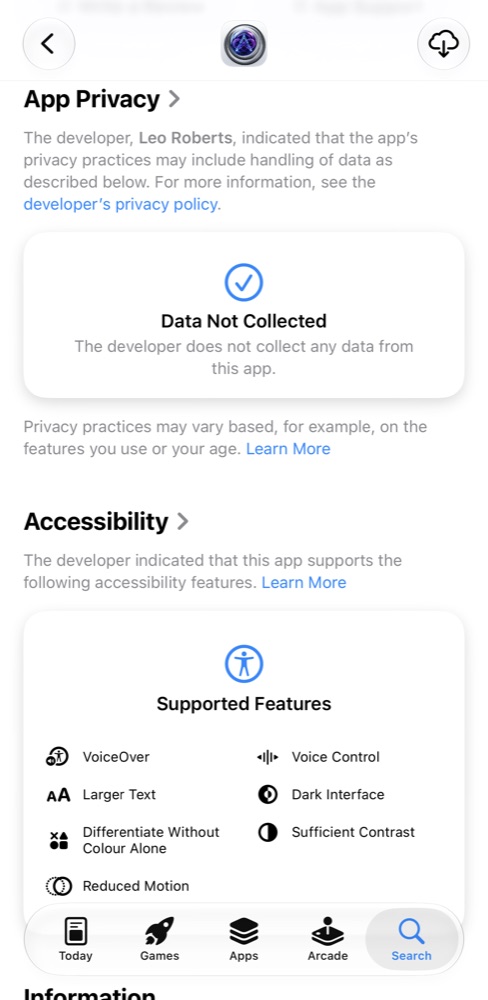
Because of this, every row of Apple's App Privacy label for A E T H Y R can honestly read "No data collected" — the strongest answer Apple allows a developer to give. This is true only for as long as it stays true: if a server or any kind of tracking is ever added to A E T H Y R, this policy and A E T H Y R's privacy label will change to say so, before it takes effect where practicable.
Search — where your words go, and the one thing A E T H Y R keeps
This is the biggest difference between the two apps, so it is worth being clear about. Aethyr ADHD's search is walled: it fetches a page from a hand-reviewed list of trusted sources and shows you stripped plain text, so you never actually visit a site. A E T H Y R works differently, and in two ways at once.
The hand-reviewed list. Look Up opens on a set of headings — food, car and garage, what's on, money, housing, work, family, learning and the rest — each with suggested searches written and reviewed by hand. Tapping one of those runs that search, and which chips you tap is not recorded.
Typing anything. You can also simply type, and you are not held to the headings — that is what "opened up" means. A small number of categories are refused outright; those searches are never run, never sent anywhere and never remembered.
What is sent when you search. This is A E T H Y R only — Aethyr ADHD does not work this way, and chapter 02 above describes what it does instead. Your typed words are sent to DuckDuckGo, the search provider A E T H Y R uses, and the results open in Safari. Only your typed words go — never your journal, your entries, your health data or your identity. A E T H Y R asks not to be profiled and keeps nothing from the request. DuckDuckGo, and any site you then visit, handle it under their own privacy policies, exactly as if you had opened Safari yourself: the site sees your IP address and can set its own cookies, and A E T H Y R can neither see nor control that.
Searches you type come back as shortcuts. A E T H Y R remembers phrases you have typed into Look Up, on that phone, so they are there next time. They are never sent to us or to anyone else, and a single button in Look Up erases all of them.
Looking up a medicine. When you look up a medicine, A E T H Y R opens the official medicines regulator for your device's region — around twenty are recognised — or a general search where it has no regulator for that country. Opening one necessarily tells that regulator's website which medicine you looked up, because that is the page you land on. Nothing about that lookup is sent to us.
Helplines. The support organisations listed at the bottom of Settings open as ordinary web pages or phone calls. Visiting one is seen by that operator the same way any visitor is seen — nothing hidden, and nothing A E T H Y R can prevent.
On-device intelligence
A E T H Y R's intelligence, including Ask Aethyr, runs entirely on your own device — the same commitment made for Aethyr ADHD throughout this policy. Nothing you type is sent to a server, a cloud, or to us.
Speech never leaves your device
A E T H Y R requires your speech to be turned into text on the device itself. If that is not available for any reason, A E T H Y R refuses to listen rather than sending your voice to Apple's transcription servers instead. Your voice is never sent anywhere — not to Apple, not to us.
iCloud backup and special category data
If you have iCloud enabled on your device, A E T H Y R's data — including medications, dosing history, vitals and health notes — is included in your own private storage, inside your own iCloud account. This is Apple's infrastructure, under your Apple ID: we hold no copy of it and cannot access it. Some of what's included — medication and health information — is what UK GDPR classifies as Article 9 "special category data." It is named here for that reason. It is still never seen by us; it leaves your device only inside your own encrypted iCloud backup, under Apple's own terms, and you can turn iCloud backup off for A E T H Y R at any time in your device's iCloud settings.
Retention — nothing is deleted automatically
Unlike Aethyr ADHD, A E T H Y R has no automatic deletion. There is no rolling six-month window and no 30/90/180/365-day choice. Medication logs, vitals, diary entries and everything else you enter are kept until you delete them yourself. Chapter 07 above describes Aethyr ADHD's retention windows; none of it applies to A E T H Y R. Nothing you write is gated, locked behind a paywall, or removed if a subscription lapses — what you have written stays yours and stays readable.
Changes, contact and important limits
Both apps
If information handling changes, this policy and its updated date will change. Material changes will be reflected in the app or website before taking effect where practicable.
Leo
aethyr@aethyradhd.com
www.aethyradhd.com
Aethyr ADHD and Aethyr are supportive organisational tools. Neither is a medical device and neither provides medical advice. Follow qualified professional guidance for medical, health, safety, legal or emergency matters.